

Головна »
Equality, stress and workload: how Ukrainian women feel during the war
“Don’t assume – ask!” One of the main rules of an inclusive approach prompted the teams of Terra U and Biasless (NGO “The Day After Tomorrow”) to survey 1029 Ukrainian women a year after the start of the full-scale invasion to better determine how they feel during the full-scale war and how they assess the dynamics of changes in their social role over the past year.
It is clear that the forced displacement, greater workload in the areas of responsibility “Children,” “Elderly relatives” and “Relationships with partner” combined with stress and the need to earn money have significantly increased the amount of what experts call the second and third shifts. (The first shift is work, the second is household chores and life, the third is coordination of family life, namely planning vacations, children’s education, family social activities, etc.)
What is this fatigue from increased workload, stress, and increased responsibilities? Does it have derivatives? For example, increased attention to equality in society and improvement of the situation with women’s professional realization. To find out what is happening in this area, according to Ukrainian women themselves, Terra U, together with Biasless, conducted a survey among women in April 2023.
More stress and responsibility
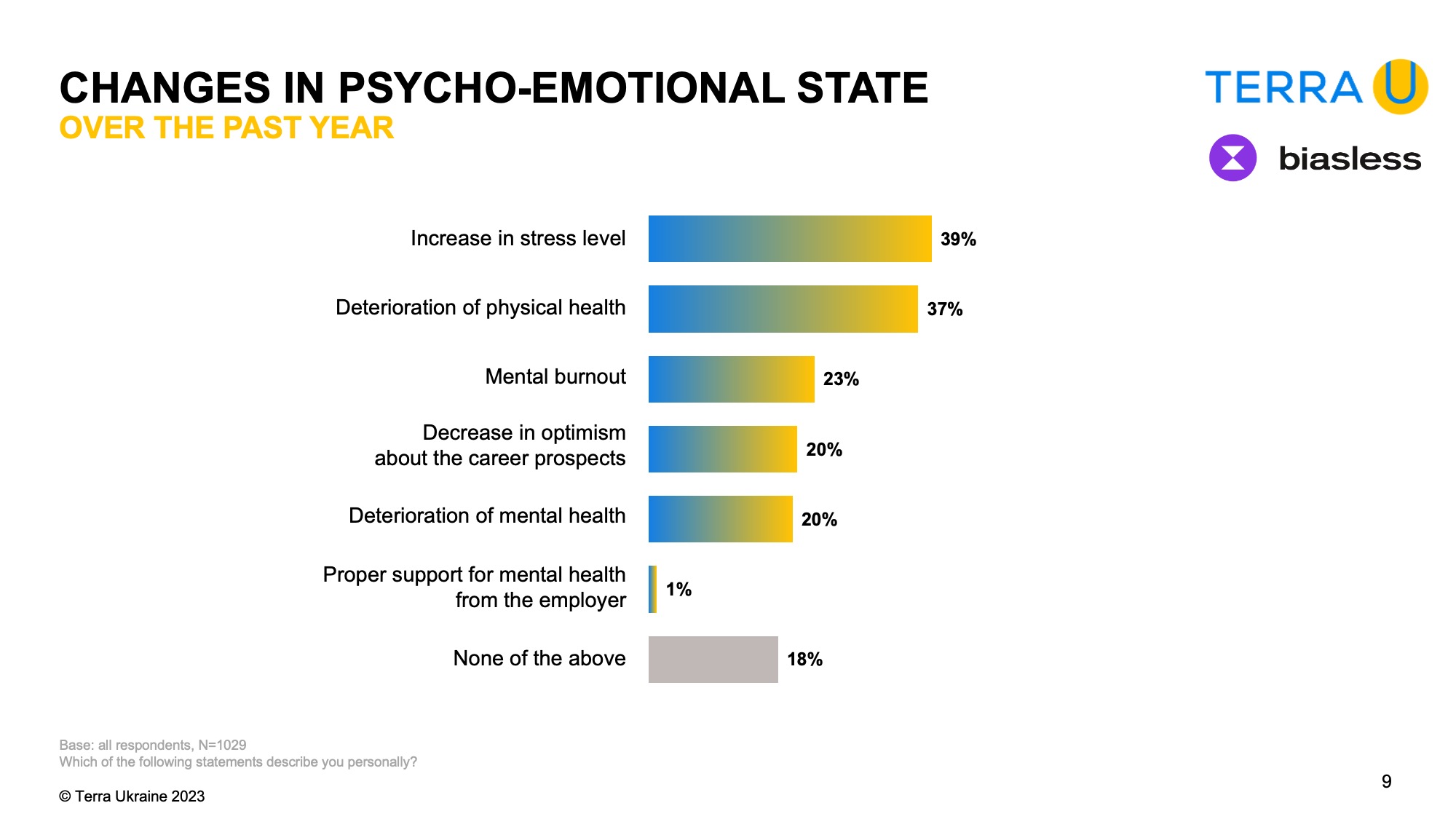
Amid the accumulation of fatigue from the war, intense shelling, and very unclear prospects for the stage of future “relief,” more than a third of respondents declare a higher level of stress (39%) than a year ago and a deterioration in physical health (37%). Next on the list are burnout (23%), decreased optimism about their own career prospects (20%), deterioration of mental health (20%), etc. And, unfortunately, under these conditions, only 1% of respondents say they receive adequate psychological support from their employer.
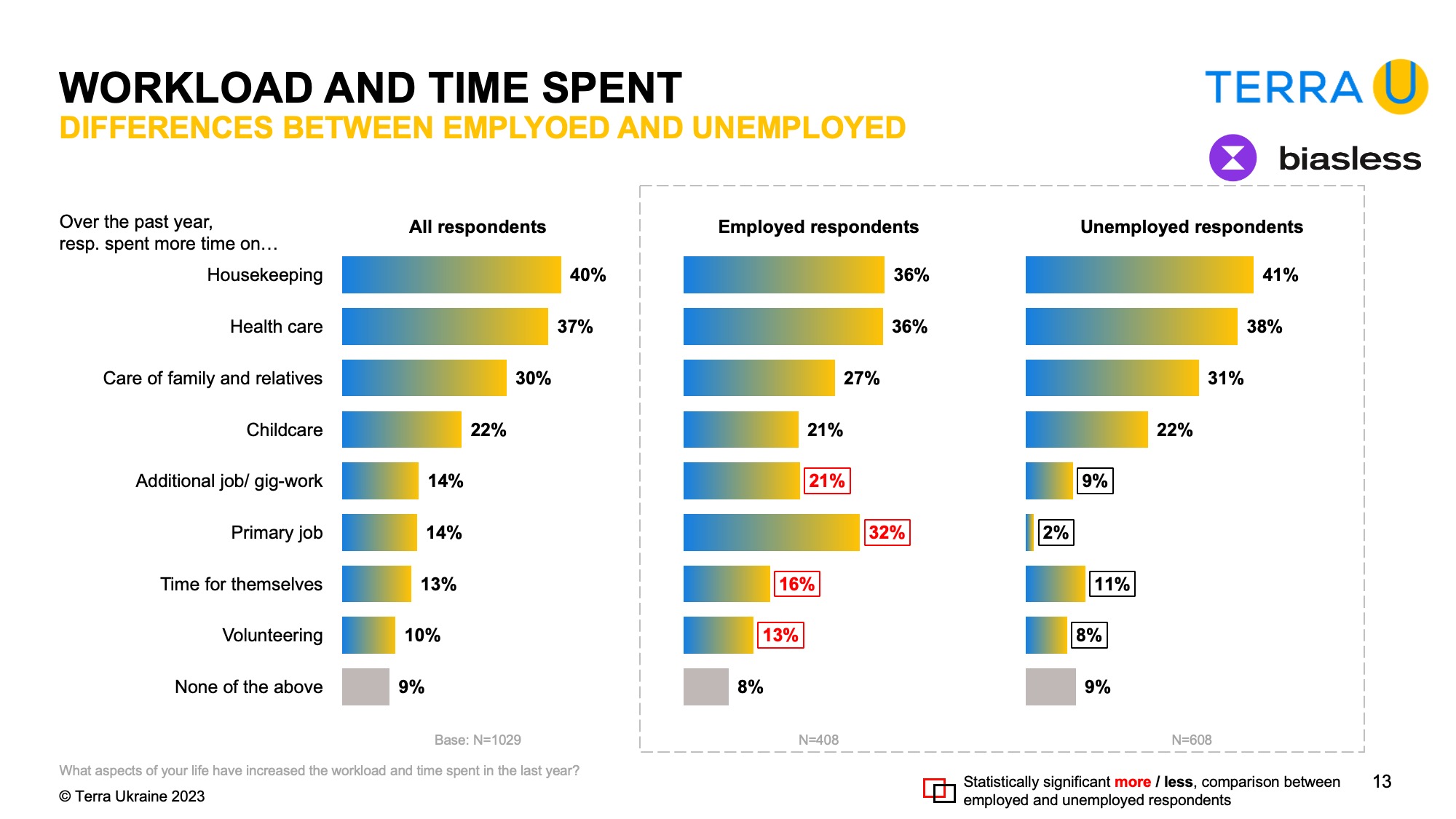
Quite predictably, in addition to psycho-emotional stress, 40% of women surveyed say that their workload with household chores has increased significantly over the past year, equally among those who work and those who do not. Taking care of health (37%) is in second place, and caring for family members and friends (30%) is in third place.
The situations and reasons may vary: for example, due to internal migration amid the war, a wider circle of family members unites to live together, which can increase the number of household responsibilities and the need to care for loved ones. Or, on the contrary, women’s workload may increase due to separation from relatives who used to support them in their business. Taking care of health obviously stems from the situation of its deterioration, but increased attention to this area is a good sign: women do not forget to take care of themselves.
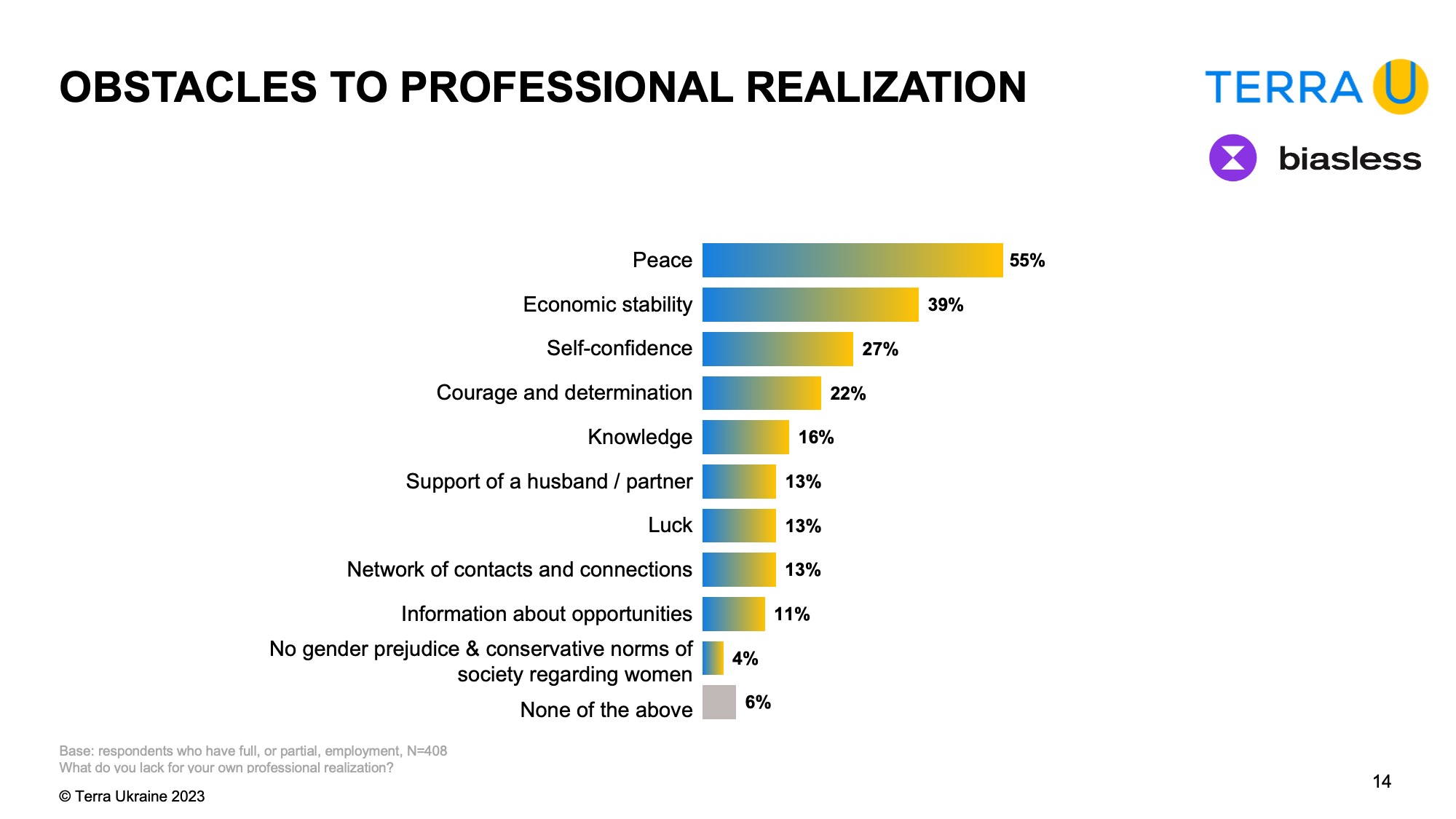
Another important area we studied was professional fulfillment. Currently, half of the respondents report that they lack peace for professional fulfillment, followed by a lack of economic stability (31%). Self-confidence and determination are the things that the war has deprived almost every fifth Ukrainian woman of.
Gender bias was mentioned as a barrier by only 2% of Ukrainian women. But this is more likely a testament to the dominance of conservative, well-established, critically unthinking traditional approaches than a victory. It’s just an indicator of gender blindness, and because of it, increased vulnerability to inappropriate attitudes (bullying, harassment, abusive behavior, microaggressions, discrimination, etc.).
Over the past year, 59% of Ukrainian women have found themselves in situations of inappropriate treatment at work. However, only 22% reported these cases to their managers. The rest, namely 37% of respondents, categorized their reasons for keeping silent among the following factors: (1) they did not feel that the behavior or insult was sufficient to file a complaint, (2) they feared that it would only make the behavior worse, (3) they were not sure that the complaint would be taken seriously, (4) they did not have enough evidence and/or witnesses to file a complaint, (5) they were concerned that reporting the problem would negatively affect their career.
A greater sense of equality and opportunities for professional fulfillment
69% of the women we interviewed answered affirmatively to the question about the improvement of respect and equality since the beginning of the full-scale invasion. And the respondents attribute a significant role in this progress to women in the Armed Forces. In particular, 87% of respondents believe that women in the military (currently 60,000 in the Armed Forces, 5,000 of whom are fighting on the front line) contribute to the visibility of women, debunking stereotypes that professionalism is gendered, thereby accelerating progress in terms of gender justice in Ukraine. Women in the military demonstrate that a woman’s place is wherever she wants it to be, and they clearly show that patriotism and the ability to fight for the homeland are areas of responsibility that are not divided into men’s and women’s.
The study of the well-being of Ukrainian women was conducted by Terra U in cooperation with Biasless using a self-completion questionnaire in the Gradus mobile application. Sample: 1029 respondents aged 18+. The sample reflects the structure of the target group by age, macro-regions, and settlement size, except for the temporarily occupied territories and territories where military operations are underway. Period of the survey: April 6-8, 2023.